How to Answer 'How Much Is It?' and Make the Sale
Price inquiries are not a rejection, but an opportunity.
Hello there. I'm Y, a dedicated partner to the passionate and hardworking small business owners and entrepreneurs grinding it out every single day.
If you run a physical store or offer a service, you know this feeling all too well. It’s that sinking sensation when a customer walks in, glances at a product, and asks the fateful question: 'How much is this?'
The moment you state the price, their face goes blank, and they turn and walk out without another word.
It feels like all the value you’ve carefully built into your product has been dismissed before you even had a chance to present it. Having coached countless business owners, I’ve heard this story of frustration time and time again.
But I'm here to tell you, with absolute certainty, that this moment is not a rejection. The customer's price question is not a final judgment on your worth. Think of it differently. It’s a hidden request, a quiet invitation that says, 'Please convince me why this product is worth this amount of money.'
It is, without a doubt, the single best opportunity you have to open a genuine dialogue. So how do we seize this golden moment and turn it into a sale? Today, I’m going to break down the specific conversational techniques that will boost your sales conversion, all based on my years of hands-on experience.
The First Step to Flipping the Script: Ask a Question About Value
The most common mistake we make is answering a question about 'price' with nothing but a 'price.' Responding with just a number is like willingly ending the conversation yourself.
The moment a customer hears a figure, their brain immediately jumps into a binary mode of 'expensive' or 'cheap.' Nine times out of ten, they'll land on 'expensive' and head for the door.
To change this outcome, you need to take control of the conversation from the very beginning. The key to doing this lies in asking a counter-question—a strategic query that shifts the focus from cost to the customer's core needs and problems.
Let’s compare two scenarios for a client asking about my business consulting programs.
[The Failed Approach]
Client: 'What are your consulting fees?'
Me: 'It's $300 per hour.'
(An awkward silence follows, usually broken by a noncommittal 'Okay, I'll think about it.')
[The Successful Approach]
Client: 'What are your consulting fees?'
Me: 'Thanks so much for asking! Before I get into the pricing, would you mind if I asked what specific challenges you're currently facing in your business? I want to make sure I can propose the best possible solution that actually solves your problem.'
See the difference? By redirecting the conversation from the price to the client's 'need' and 'problem,' you instantly buy yourself invaluable time. This opening allows you to understand their situation, diagnose their pain points, and then frame your service not as a cost, but as a crucial, value-packed solution tailored specifically for them.

Disarming Price Resistance with a 'Value-First' Conversation
Once you've successfully identified the customer's need, it's time to deploy the art of the value-first dialogue.
Your goal is to dismantle their natural resistance to the price. Here's the golden rule: the price should always be the very last piece of information you reveal. What makes a customer accept a price isn't the number itself, but the perceived *size of the value* that justifies it.
I call this 'value storytelling.' You must first create a rich narrative around your product or service, fully explaining its story, its unique benefits, and, most importantly, the concrete, positive outcome the customer will gain from it.
Imagine a customer in a specialty coffee shop asking about a bag of high-end beans. Instead of just saying, 'That's $30 for 100 grams,' you engage in value storytelling: 'Oh, you have an excellent eye for coffee!
That particular bean is a specialty-grade Yirgacheffe, harvested from a high-altitude region in Ethiopia during a very specific two-week window each year.
That's why it has such an extraordinary acidity and a unique floral aroma. When you brew this at home, you'll be creating a café-quality experience that's hard to find anywhere else.'
After you've painted this vivid picture and built up the perceived value, the price you state no longer sounds like an expense. The customer is far more likely to see that '$30' as a worthy investment in a unique and special experience.
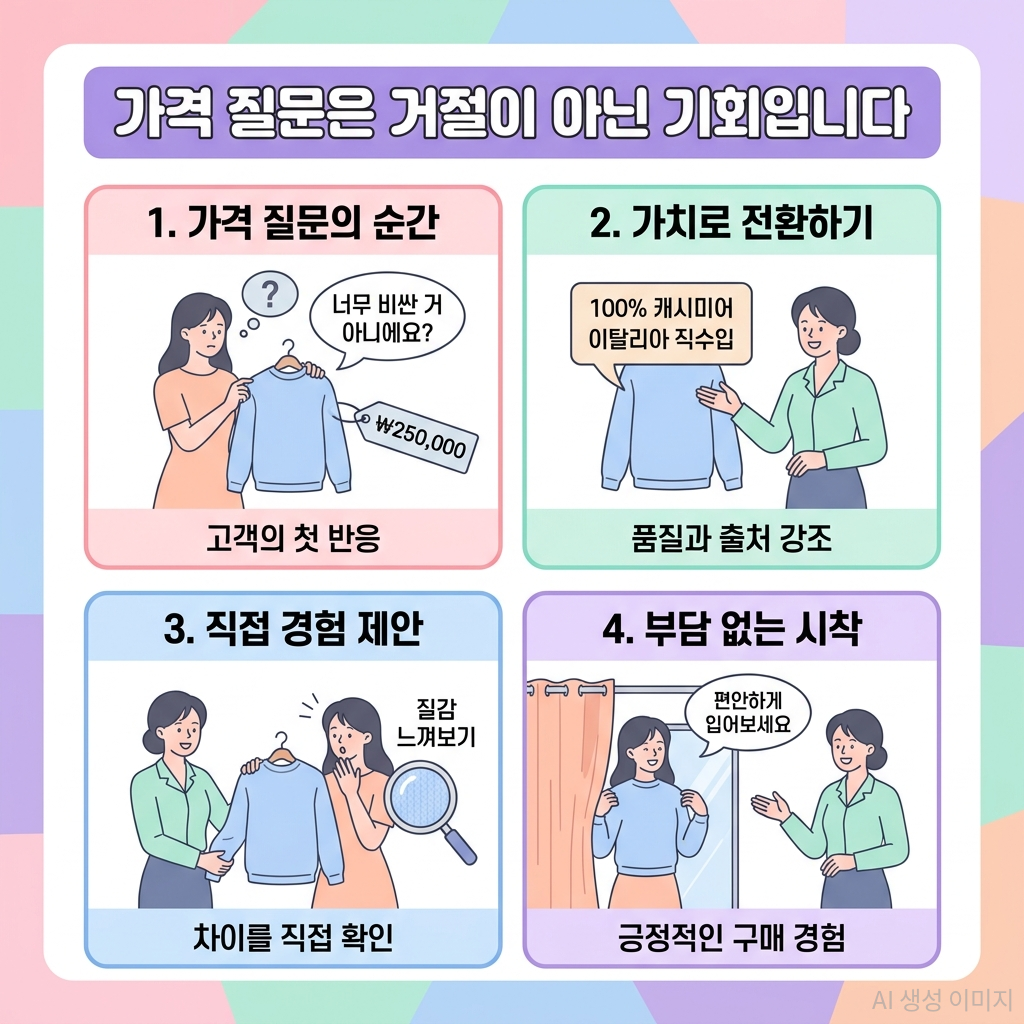
An Actionable Checklist: Industry-Specific Tips You Can Use Today
To help you put this into practice immediately, here are a few industry-specific tips. The core strategy is always to offer an experience, build trust, and showcase your expertise before you ever mention the cost.
Apparel / Fashion Accessories: 'That's a $250 piece. It’s made from 100% cashmere imported directly from Italy. Here, just feel the difference in the texture—you can immediately tell it's special.
Please feel free to try it on; there's no pressure at all. I want you to see how it drapes.' By inviting them to touch and try the item, you shift their focus from the abstract price tag to the tangible, luxurious experience.
The physical connection to the product makes the value proposition feel real and immediate.
Gym / Pilates Studio: 'Great question. A 3-month membership is $600. But before anyone signs up, we have our professional trainers conduct a complimentary body composition analysis and a goal-setting consultation.
This helps us tailor a plan specifically for you. Do you have a few minutes now?
I’d be happy to get you started with a free consultation.' This approach reframes the membership from a simple fee for access into a personalized, expert-guided wellness journey.
The upfront investment of your time builds immense trust and demonstrates the premium value you provide.
Handmade Goods / Artisan Bakery: 'That cake is $9 a slice. We make it fresh every single morning using only premium French butter and real, full-fat heavy cream. We never use any artificial substitutes.
I can honestly say you won't regret trying it. In fact, we have a tiny tasting piece right here. Would you like to try it?'
Offering a sample is a powerful tool. It leverages the psychological principle of reciprocity while allowing the undeniable quality of your product to do the selling for you. Once they’ve tasted the difference, the price becomes a secondary consideration.
'It's Okay if You Don't Buy Today': The Art of the Lasting Impression
Despite your best efforts, some customers will still hesitate or decide to walk away. Showing any hint of disappointment at this stage is the worst possible response.
Remember, the final impression you make can determine whether they ever come back. This is where you need a graceful closing line that secures a positive connection and opens the door for a future visit.
You are no longer trying to close a sale; you are trying to open a long-term relationship.
Instead of a cold 'Okay,' try something warm and inviting. 'Of course, please take your time to think it over and look around some more.
Just in case, let me give you my business card. We're always getting new items in, and I'd be happy to show you some other options next time you're in the area.' Deliver this with a genuine smile. Another excellent strategy is to bridge the physical visit to an online relationship.
'By the way, we announce all our new arrivals and special promotions on our Instagram first. Feel free to give us a follow if you'd like to stay in the loop!' This small effort transforms a lost sale into a new follower and a warm lead, keeping your brand top-of-mind and paving the way for their return.
The price question is not a crisis. It is the perfect opportunity to showcase the true, deep value of what you offer. I encourage you to adapt these methods to your own business and watch as you begin to turn departing footsteps into loyal, returning customers.
📚 Read the full Korean version on our Naver Blog — with original photos and customer reviews.
📚 Looking for more details? Visit the Tistory version for in-depth notes and search keywords.
📚 Prefer Korean? Check the Google Blogger(Korean) version of this article.


댓글
댓글 쓰기